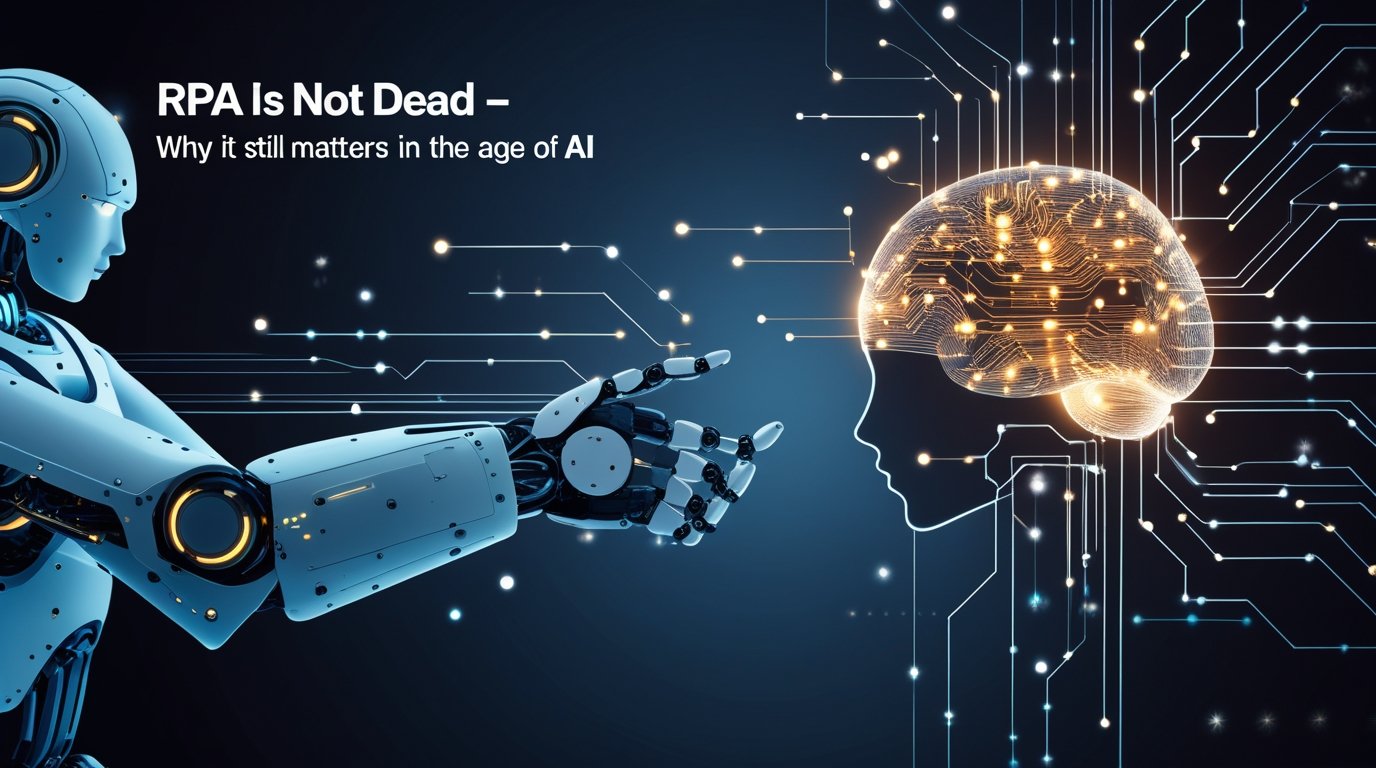
Let’s just get this out of the way. You’ve seen the headlines. “AI is going to make RPA obsolete.” “Why automate tasks when you can automate thinking?” It sounds smart. It sounds forward-thinking. And honestly? It’s a load of nonsense. I’ve been in enough boardrooms and talked to enough frazzled operations managers to tell you that reports of RPA’s death have been greatly exaggerated. In fact, in the age of AI, it’s more relevant than ever. But it’s not the star of the show anymore. It’s the rock-solid, reliable stage crew that makes the AI magician look good. Let’s break down why dismissing RPA is a luxury only people who’ve never had to actually run a business can afford.
Look, Someone’s Gotta Do the Grunt Work:
All this AI hype is like everyone’s obsessed with hiring a celebrity chef. They’re amazing, creative, brilliant. But who’s washing the dishes? Who’s chopping the mountains of vegetables? Who’s making sure the fridge is stocked?
That’s RPA.
Your fancy new AI might be able to analyze a contract in seconds. But can it log into the seven different legacy systems your company still runs on to update that contract information? Can it open the PDF invoice in one program, copy the data, and paste it into the accounting software from 1998 that your CFO refuses to retire?
No. It can’t. Because AI doesn’t have fingers. RPA is the digital workhorse that does the clicking, the copying, the pasting, all the boring, repetitive stuff that humans hate and that absolutely must get done for the business to function. Ignoring RPA is like building a Formula 1 car but forgetting you need a pit crew to change the tires.
AI is the Brain, RPA is the Hands:
This is the part everyone misses. This isn’t a cage fight. It’s a marriage.
Let me paint you a picture. An insurance claim comes in. It’s a messy scanned document, a handwritten form with coffee stains.
- The AI’s Job: The AI looks at this mess. It reads the sloppy handwriting. It identifies the policy number, the claim details, and the amount. It’s smart. It understands context. It might even flag it for potential fraud based on weird phrasing.
- The RPA’s Job: The AI figures all this out and says, “Okay, here’s the clean, structured data.” Then the RPA bot wakes up. It logs into the mainframe. It navigates to the claims processing screen. It types in the policy number. It tabs to the next field and enters the amount. It clicks ‘Submit’.
See how that works? The AI does the thinking. The RPA does the doing. The AI handles the fuzzy, unpredictable stuff. The RPA handles the precise, repetitive actions. Trying to use one without the other is like having a brilliant strategist with no army, or an army with no general.
RPA is Your On-Ramp to the AI Highway:
Let’s be real. Most companies aren’t Google. Their data is a mess. They have legacy systems held together with digital duct tape and prayers. The idea of implementing a full-blown AI strategy is terrifying.
RPA is the perfect first step. It’s like training wheels for automation.
You start small. You use RPA to automate one tedious process, like pulling data for a weekly report. It works. People see the value. They get comfortable with the idea of a “digital worker.” You build momentum.
Then, you can introduce AI. You can say, “Hey, that bot that pulls the report… what if we added a little AI to it so it could also analyze the report and tell us the three most important takeaways?”
That’s a much easier sell. RPA builds the foundation of trust and process clarity that AI needs to be successful. It’s the gateway drug.
The Bottom Line:
The business world is obsessed with the next shiny thing. But while everyone’s chasing generative AI, the real, hard work of running a company still happens in the trenches. In the spreadsheets. In the data entry. In the systems that were old when your dad was working.
RPA isn’t glamorous. It’s not going to write you a poem. But it will get your payroll processed on time. It will ensure your customer data is accurate. It will free up your human employees from soul-crushing work so they can actually do things that require a human brain.
So no, RPA isn’t dead. It’s the unsung hero. It’s the plumbing. And you don’t realize how essential it is until it stops working.
FAQs:
1. What’s the main difference between RPA and AI?
RPA copies human actions (clicking, typing), while AI tries to copy human judgment and reasoning.
2. Can RPA work with old systems that don’t have a modern API?
Yes, that’s its biggest strength; it works through the user interface, just like a person sitting at the computer.
3. Is my RPA investment wasted if AI takes over?
Not at all; think of RPA as the foundation. AI will make your RPA bots smarter, not replace them.
4. What’s the biggest mistake companies make with RPA?
Automating a broken process. You just get faster chaos. Fix the process first, then hand it to the bot.
5. Do I need a team of data scientists to use RPA?
No, that’s the beauty of it. Many RPA tools are designed for business users to configure themselves.
6. What’s a simple task perfect for RPA?
Anything you do more than once a day that involves moving data between two programs you can’t get to talk to each other.

Related Posts